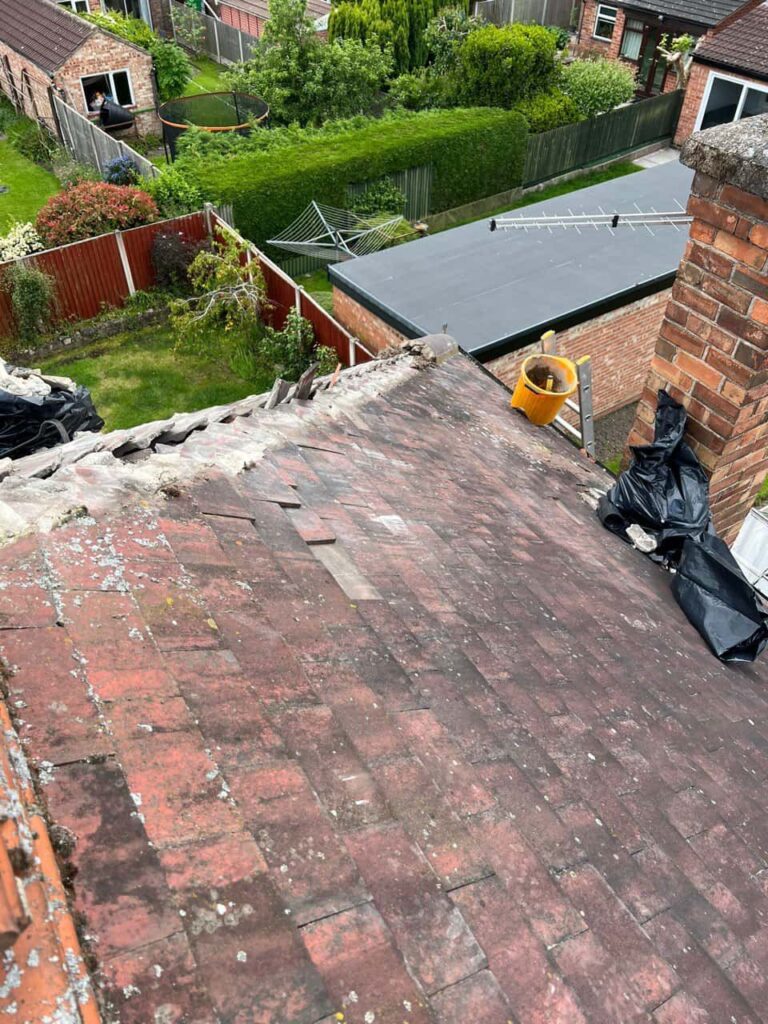
A roof leak that returns after previous repair work can be frustrating and confusing. The immediate assumption may be that the earlier repair has failed, but recurring water ingress is not always that straightforward. The original leak may have had more than one cause, water may be entering from a different point, or deterioration may have developed in another part of the roofing system.
Roof leaks can also be difficult to trace because the location where moisture becomes visible inside a property is not necessarily where rainwater first entered the roof.
For homeowners in Earl Shilton, Leicestershire, understanding why a leak has returned is important before further work is carried out. A fresh assessment can determine whether the previous repair needs attention or whether another roofing defect is responsible.
What Causes a Roof Leak to Return After It Has Been Repaired?
Recurring leaks can develop for several reasons, and identifying which one applies is essential if the problem is to be resolved effectively.
Possible causes include:
- The original source of water ingress was not fully identified
- More than one roofing defect was present
- Water is travelling from another section of the roof
- Surrounding roofing materials have subsequently deteriorated
- Flashing or roof junctions require further attention
- Underlay beneath the roof covering has deteriorated
- Valleys or drainage details are contributing to the problem
- A new and unrelated defect has developed
- Wider roof deterioration is beginning to affect several areas
A returning leak should therefore be investigated rather than automatically assuming that repeating the previous repair will solve it.
The Original Leak Source May Have Been Difficult to Identify
One of the biggest challenges with roof leak repair is locating the exact point where water enters.
An internal ceiling stain may appear to identify the problem area, but water can travel beneath tiles or slates before reaching the interior. It may follow underlay, timbers or other components and eventually become visible some distance from the original defect.
If previous work concentrated mainly on the roof directly above the internal damp patch, the actual entry point may have remained untreated.
A fresh assessment should consider the possible route taken by the water rather than focusing solely on where the symptom appears.
The Previous Repair May Still Be Performing Correctly
A recurring leak does not automatically mean that previous roofing work has failed.
It is possible for one defect to be repaired successfully while a separate weakness develops nearby or elsewhere on the roof. From inside the property, the resulting dampness may appear in a similar position, making the two problems seem connected.
This is particularly important on roofs with several vulnerable details located close together.
Before altering a previous repair, it is worth establishing whether that section is actually allowing water through or whether another component has become responsible.
There May Have Been More Than One Defect
Sometimes several small roofing problems contribute to the same internal symptom.
For example, one damaged component may allow water through during ordinary rainfall, while another vulnerable detail only leaks during prolonged or wind-driven rain. Correcting the first problem may significantly improve the situation without eliminating the second.
The leak can then appear to have returned even though one of its original causes has been successfully addressed.
A broader assessment of the surrounding roof can help identify connected defects that may not have been obvious initially.
Water Can Travel Considerable Distances
The path taken by water within a roofing system can make recurring leaks particularly difficult to diagnose.
Once rainwater passes through the external covering, it can move down the roof slope or along other surfaces before finding a route into the property.
Wind can also influence how water enters, particularly around tiles, flashing and junctions.
Understanding the conditions in which the leak occurs can provide useful clues. A leak that only appears during strong winds may have a different cause from one that develops after prolonged rainfall.
Flashing Can Be Responsible for Recurring Water Ingress
Flashing protects areas where roof surfaces meet walls and other building features.
These locations require careful weatherproofing because they involve changes between different surfaces and materials. A relatively small weakness can allow repeated water ingress.
Where flashing is involved, the visible symptom may appear away from the actual defect because water can travel behind surrounding materials.
A thorough inspection should therefore consider the complete flashing detail rather than simply treating the section closest to the internal dampness.
Valleys Can Produce Persistent Roof Leaks
Roof valleys carry water from adjoining slopes and can handle substantial volumes during rainfall.
A localised problem within a valley can therefore cause significant water ingress. Deterioration may also extend beneath neighbouring roof coverings, making the true extent of the defect difficult to determine from ground level.
If a previous repair addressed only one visible section, another vulnerable area within the same valley may continue to allow water through.
Assessing the valley as a complete detail can provide a clearer understanding of recurring problems.
Deteriorated Underlay May Contribute to the Problem
Tiles and slates provide the primary external roof covering, but the underlay beneath them also has an important role.
Where water passes beneath the covering, suitable underlay can help manage moisture. If the underlay has deteriorated or become damaged, water may find routes further into the roof.
Because this component is concealed, its condition is not always obvious during a basic external inspection.
Where leaks repeatedly affect the same general area, assessing relevant underlying materials may be necessary to determine whether the visible surface defect tells the whole story.
Surrounding Roofing Materials Can Change Over Time
A repair may have been completely appropriate when it was originally carried out, while neighbouring materials subsequently deteriorate.
Roof coverings and details are exposed continuously to weather, and individual components do not always deteriorate at exactly the same rate.
A previously sound tile, fixing or section of flashing can develop a separate problem later.
This is another reason why a returning leak should be assessed according to the roof’s current condition rather than assuming that the previous defect has simply reopened.
Repeated Leaks Can Indicate Wider Roof Deterioration
One recurring leak in a specific area can still be a localised problem. Several leaks appearing across different parts of the roof present a different situation.
If tiles are becoming increasingly fragile, multiple details are deteriorating or water ingress is developing independently in several areas, the roof may be experiencing broader deterioration.
At this stage, continuing to focus only on whichever leak appeared most recently can overlook the overall condition of the roofing system.
A whole-roof assessment can determine whether the individual problems are connected.
Previous Surface Treatments May Have Addressed Only the Symptom
There is an important difference between temporarily stopping visible water ingress and repairing the roofing defect responsible for it.
A surface treatment may sometimes reduce moisture entering through an obvious opening, but if the actual weakness lies beneath or around another component, the improvement may not last.
Effective roof repair should restore the function of the affected area.
This means understanding why water can enter and addressing the relevant roofing components rather than simply covering the point that appears most suspicious.
The Pattern of the Leak Provides Useful Information
Homeowners can often provide valuable information about when a leak appears.
Does it happen immediately when rainfall begins, or only after several hours? Is it noticeably worse when rain is accompanied by strong wind? Does the damp area remain in exactly the same place, or has it changed?
These observations do not replace professional diagnosis, but they can help indicate how water may be entering and travelling through the roof.
The more clearly the behaviour of the leak is understood, the easier it can be to investigate the relevant roofing areas.
Why Repeating the Same Repair May Not Be the Answer
When a leak returns, carrying out exactly the same work again without reassessing the roof may fail to resolve the issue.
The condition may have changed, another defect may have developed or the original problem may extend beyond the previously repaired section.
Starting with a fresh diagnosis allows the roof to be considered as it exists now.
This approach is particularly valuable when previous repairs have provided only temporary improvement or when the source of water ingress remains uncertain.
Does a Recurring Leak Mean the Roof Needs Replacing?
Not necessarily.
Some persistent leaks are eventually traced to one difficult-to-identify but localised defect. Once that weakness is correctly addressed, the surrounding roof may continue to perform effectively.
Replacement becomes more relevant when investigation shows that recurring leaks are being caused by widespread deterioration rather than a single problem.
The decision should therefore be based on the condition of the roof as a whole, not simply the number of times water has appeared inside the property.
Why a Whole-Roof Assessment Can Be Valuable
A wider inspection provides useful context when leaks continue to return.
It can establish whether the previous repair remains sound, whether surrounding materials have deteriorated and whether other sections show similar weaknesses.
This does not mean that every part of the roof will require work.
Instead, the assessment helps separate a genuinely localised recurring defect from a wider pattern of deterioration, allowing any recommendation to remain proportionate to the condition found.
The Value of Accurate Roof Leak Diagnosis
Successful roof leak repair begins with understanding the cause.
At Earl Shilton Roofing Repairs, we assess the affected area and relevant surrounding roof details to establish where water is likely to be entering and why the problem has returned. Previous repairs can also be considered as part of the investigation rather than automatically being assumed to be the source.
For homeowners in Earl Shilton, Leicestershire, this diagnostic approach helps ensure that further work is directed towards the actual roofing problem rather than simply treating the latest visible symptom.
Conclusion
Roof leaks can return after previous repairs for several reasons. The original entry point may have been difficult to locate, another nearby defect may be contributing, surrounding materials may have deteriorated or water may be travelling from a completely different section of the roof.
Importantly, a returning leak does not automatically mean that previous work has failed or that the entire roof needs replacing. The key is to reassess the roof, identify the current route of water ingress and determine whether the problem remains localised or forms part of wider deterioration.
If a roof leak keeps returning at your property in Earl Shilton, Leicestershire, contact Earl Shilton Roofing Repairs. We can assess the affected area, investigate the underlying cause and recommend appropriate roofing work based on the condition found.
Call us on: 01455 249 592
Click here to find out more about Earl Shilton Roofing Repairs
Click here to complete our contact form and see how we can help with your roofing needs.